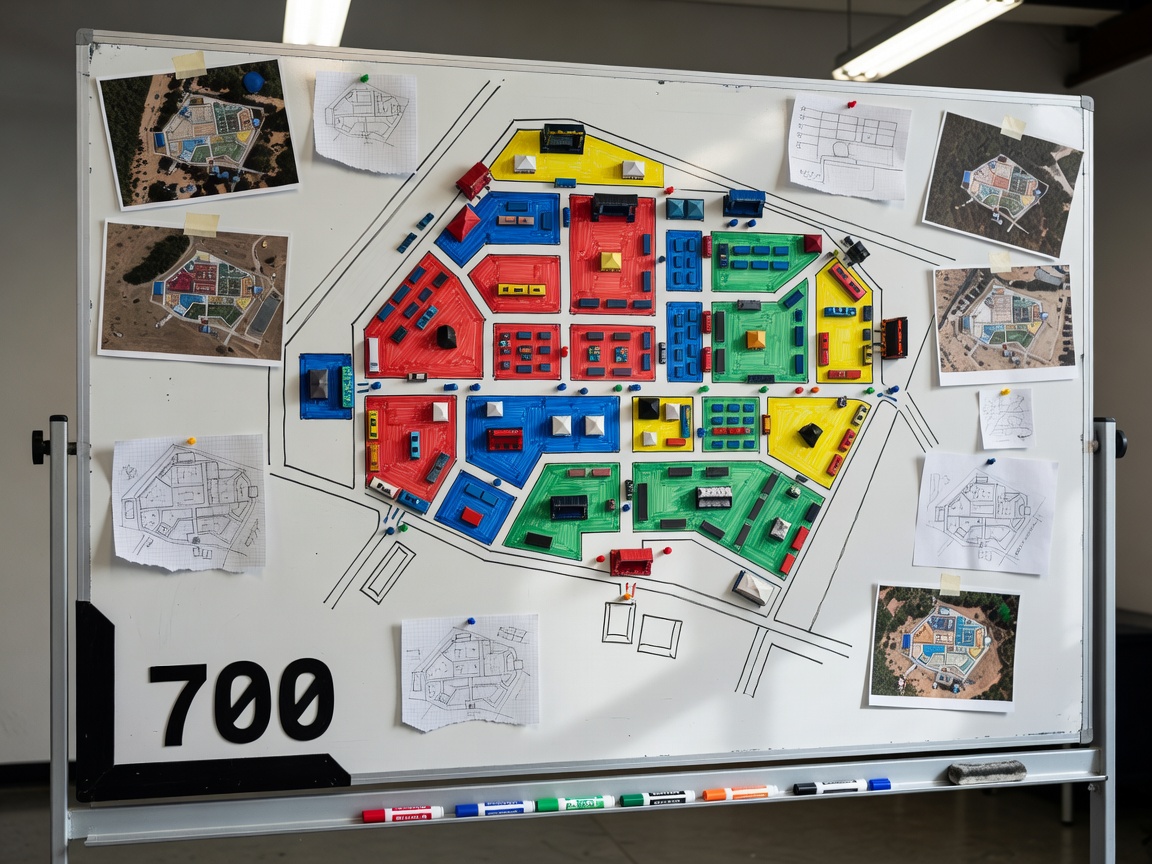
Planning is not a container list. It is a site model. Begin with the venue boundary, then mark public areas, food-service locations, backstage compounds, production zones, staff facilities and routes that must remain available. The output should be readable by event operations, suppliers and collection teams.
Map zones before equipment
Use a working map with clear zone names. Visitor areas may need distributed points close to movement routes. Food-service areas usually require different stream logic and more frequent attention. Backstage and production zones often need controlled access, different holding arrangements and a defined handover point. Mark toilets, entrances, emergency routes and restricted areas as constraints, not decoration.
The festival schedule changes the map in time. Opening periods, headline movements, food peaks, changeovers and close-down each create different pressure. A point that works during build may block a route during public hours. Keep an operating version and a build version where the site changes materially.
Set collection points with access in mind
A collection point needs more than a convenient location. Consider walking distance, visibility, separation between streams, servicing access, lighting, ground conditions and the route back to a holding area. The point should not interfere with audience circulation or create an avoidable crossing between public and service movement.
Temporary infrastructure may include containers, enclosure panels, labels, route markers and protected storage. Select equipment according to the event layout and the receiving requirements available locally. Avoid assuming that a familiar container system will suit every site.
Adjust the plan to event conditions
Festival size matters, but it is not the only variable. A compact site with intense food and beverage activity may need more detailed planning than a larger site with dispersed activity. Operating hours affect service windows. Event duration affects storage, repeat visits and post-event work. Audience movement affects where points remain usable. Weather can change ground access, cleaning requirements and the practicality of open stations.
Staffing plans should identify who checks points, who reports a full container, who authorises a route change and who records exceptions. Keep responsibilities specific. A plan that depends on everyone noticing the same issue is not a control system.
Compare planning approaches
A fixed-zone plan is simple to brief and easy to document. Its limitation is that it may not respond well to changing audience movement or temporary closures. A dynamic plan uses scheduled reviews and route changes. It is more adaptable, but needs stronger communication and version control.
Key considerations
- Mark every activity zone and access restriction.
- Separate public, food-service, backstage and production needs.
- Match collection points to movement, servicing and holding logic.
- Record peak periods and likely route conflicts.
- Define weather and access contingencies.
- Use qualified personnel for special or hazardous waste requirements.
Selection criteria
Choose a planning approach that can be updated, shared and checked on site. Prioritise legible maps, named responsibilities, realistic access windows and compatibility with local receiving arrangements. The best plan is the one that remains useful during changeover, peak operation and close-down.
Need a planning brief?
Share the event type, location, dates and operating constraints.
Plan an enquiry