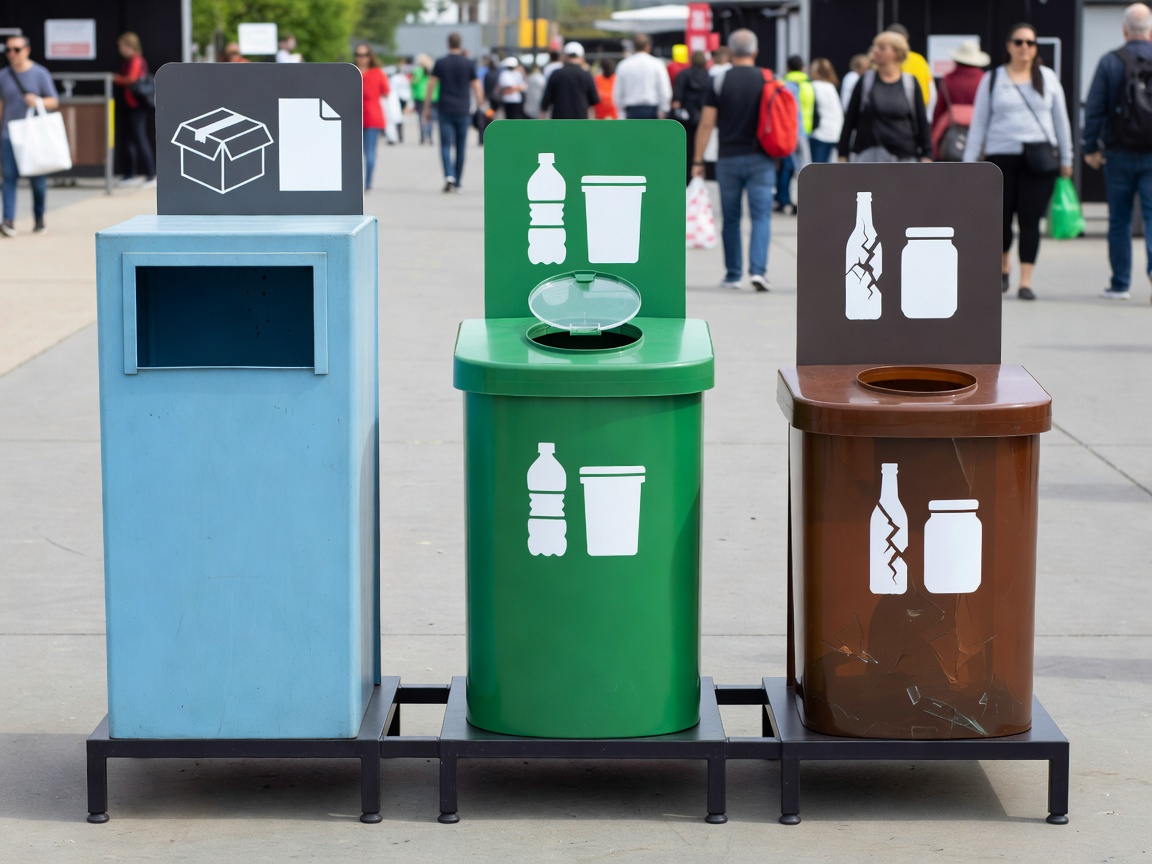
Festival recycling starts with a decision about materials, not colour coding. Review what is generated, where it appears, how it is handled and which local receiving arrangements are available. Actual recyclable streams depend on local infrastructure, material quality and receiving requirements. No material should be assumed recyclable everywhere.
Define material categories
Common planning categories may include packaging, fibre, food-service material, glass where applicable and mixed residual material. The useful categories for one event may not suit another. Consider the material composition, supplier choices, food contamination, breakage risk and storage requirements before selecting containers.
Source separation keeps material identifiable at the point of disposal. It can improve control, but it asks more of visitors, staff and vendors. A smaller number of well-understood streams may be more workable than a long list that cannot be explained or serviced consistently.
Make containers and labels agree
Labels should use plain material names, clear examples and consistent placement. Container openings should support the intended stream where practical. Keep the same visual logic across public points, vendor areas and back-of-house stations. If a stream changes by zone, state that difference directly.
Food-service waste requires particular attention. Packaging may combine materials, and food residue can affect handling. Glass may require a separate arrangement where local requirements and site conditions support it. Mixed waste remains a category to manage, not evidence that every other stream has failed.
Control contamination without overclaiming
Contamination is a material-flow issue. Monitor recurring confusion, damaged labels, misplaced packaging and unsuitable container locations. Use staff prompts and point checks rather than assuming that signage alone will resolve the issue. Any corrective action should be recorded in operational language.
Back-of-house sorting may help identify and consolidate material before onward handling. It also creates a need for trained roles, controlled areas, clear records and appropriate procedures. Hazardous or special waste must be referred to qualified personnel and handled under relevant local requirements.
Compare system designs
A broad mixed system is simpler for public use but produces less material separation at source. A multi-stream system creates clearer material categories but requires more labels, space, staff attention and receiving coordination. A hybrid design may use simple public points with more detailed back-of-house separation. Its success depends on consistent handover and records.
Key considerations
- Confirm receiving requirements before naming a stream.
- Use material-based labels and consistent examples.
- Match container openings to the intended use.
- Coordinate vendor, public and back-of-house systems.
- Record contamination patterns without inventing rates.
- Keep special-waste decisions with qualified personnel.
Selection criteria
Select the fewest streams that can be clearly explained, safely held, regularly collected and accepted by the available infrastructure. Review the system after event changes, supplier changes or a change in receiving arrangements.