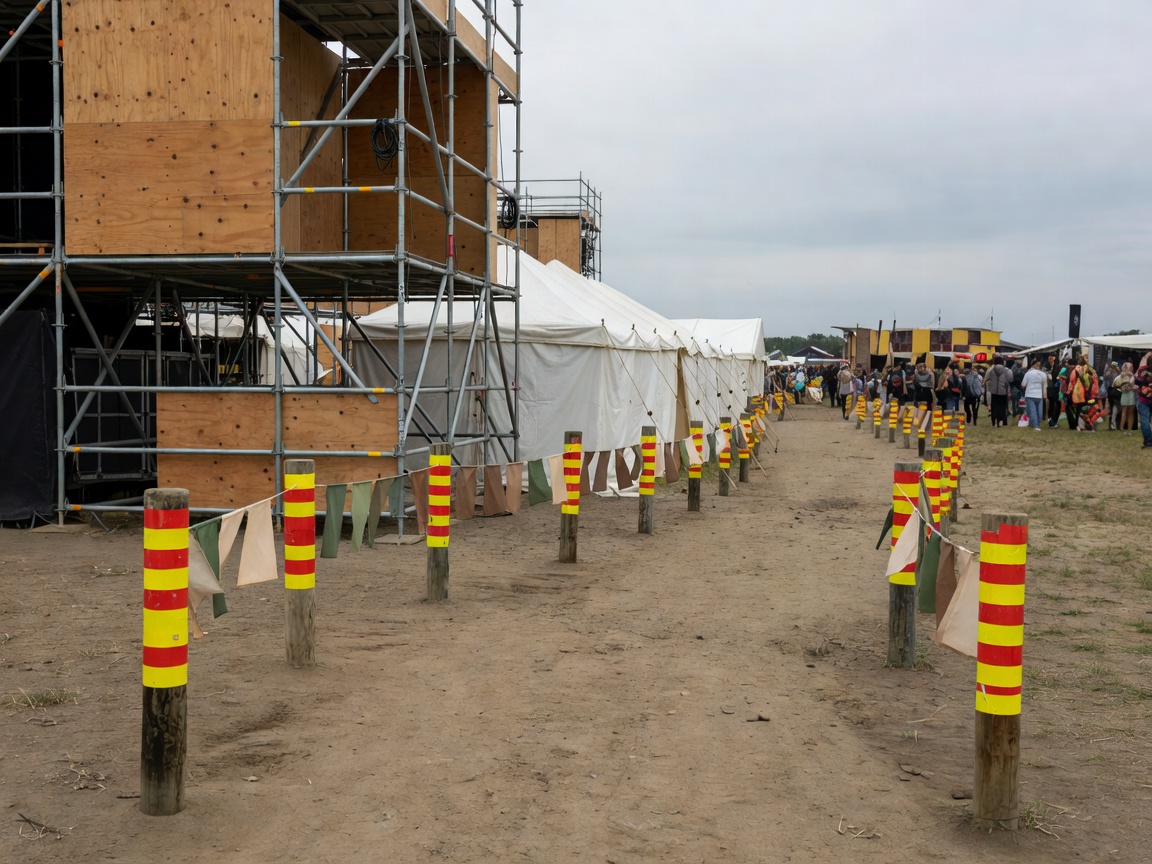
Start by identifying where material accumulates and how it reaches the collection system. Public points, food-service areas, backstage compounds and production zones rarely have identical requirements. Record the expected use of each area without turning assumptions into measured forecasts.
Build the route around access
Plot the route from collection point to temporary holding area or onward handover. Check gates, turning space, restricted periods, pedestrian crossings, ground conditions and route ownership. Access windows may be limited by sound checks, deliveries, performances or audience movement. A route that relies on unrestricted movement is a weak route.
Use a simple route sheet. Include point ID, zone, stream, container type, service window, access note and escalation contact. Version the sheet when the event layout changes. Keep public and back-of-house movements distinct where practical.
Set service frequency by conditions
Frequency should respond to use, container capacity, operating hours, weather and the consequences of a full point. Peak event periods may require review or service windows that differ from quieter periods. Food-service areas may need closer coordination than low-activity zones. Post-event collection is a separate phase and should not be treated as an automatic extension of live service.
Temporary containers need stable placement, clear labels and access for the people responsible for checking them. Consider lids, enclosure, lighting, surface conditions and protection from interference. Select the arrangement according to the site and the receiving system available.
Fixed points or distributed systems?
Fixed collection points are easy to brief and can simplify route planning. They concentrate equipment and create clear service locations. Their limitations are walking distance, local congestion and the risk of overflow where audience movement is uneven.
Distributed systems place smaller points nearer activity. They can reduce walking distance and support separated streams across a larger site. They also create more locations to check, more labels to maintain and a more complex route. The choice depends on venue layout, staffing, public behaviour, access and service control.
Weather and peak operations
Rain, wind, heat and poor ground conditions can change access and container performance. Include a weather review in the operating plan. Define who can request a route change and how that change is communicated. During peak periods, prioritise clear escalation over informal messages.
Key considerations
- Give every point a location, purpose and service window.
- Check service access against the live event schedule.
- Separate public routes from back-of-house routes where possible.
- Define full-point reporting and route-change ownership.
- Plan post-event collection as its own operating stage.
- Refer special waste to qualified personnel and documented local procedures.
Selection criteria
Choose fixed or distributed collection by access, activity, staffing and stream requirements. Prefer a system that can be explained in one route sheet, checked without ambiguity and adapted when the event changes.